
The blurting method
Read a small topic, close your notes, and write what you remember. Then compare your answer with the source. Blurting turns a vague feeling of familiarity into a concrete list of things to practise.
What is the blurting method?
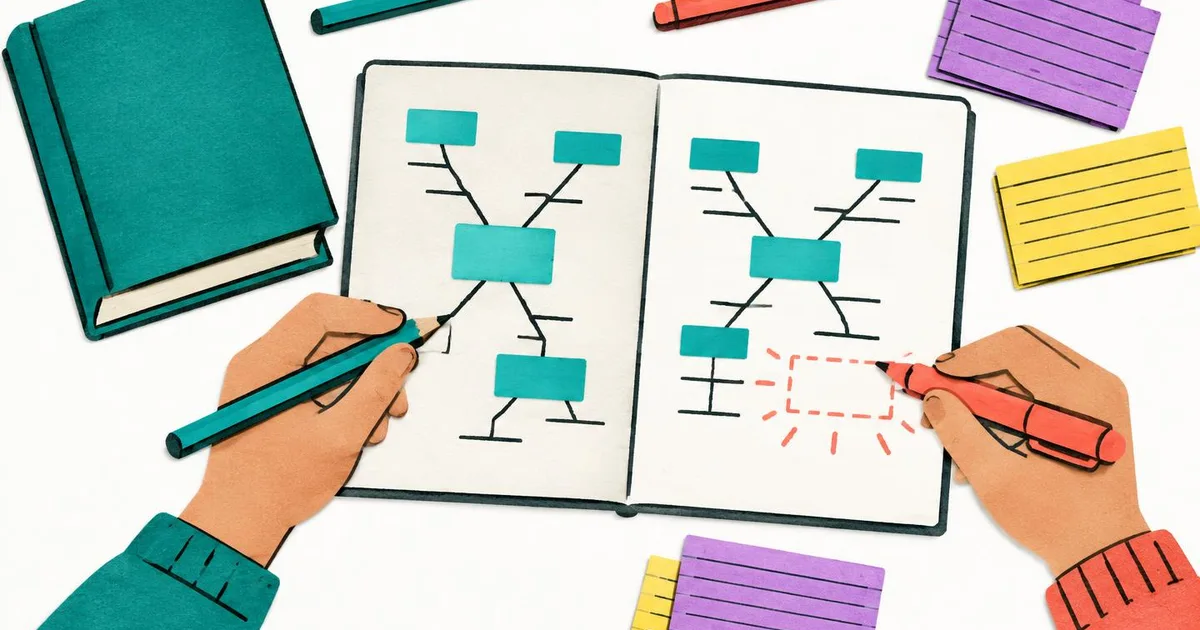
Blurting is a form of free recall: you produce what you know about a topic without looking at the material. Your output can be bullet points, a diagram, an explanation spoken aloud, or a rough paragraph. The point is not to reproduce a beautiful page of notes; it is to discover what you can retrieve unaided.
Unlike copying a summary, you put the source away before answering. Unlike a single flashcard, the prompt is broad enough to reveal connections between ideas. Use it after you have first understood the material, not as a substitute for learning it.
How to use blurting in five steps
- Choose a small, specific topic. “How water moves through a plant” is a useful prompt; “all of biology” is not. Write the topic at the top of a blank page.
- Read for understanding, then close the source. Resolve unfamiliar terms first. Put the textbook out of sight and close any tabs that contain the answer.
- Recall without checking. Write the facts, sequence, examples, and connections you can remember. Leave a question mark where you are uncertain instead of sneaking a look.
- Compare and correct. Reopen the trusted source. Use another colour to distinguish missing facts from incorrect ones. Check against your course objectives too: your notes may not cover everything required.
- Plan a delayed retry. Make targeted questions from the gaps, review the answers, and attempt the topic again in a later session. Do not only rewrite the corrected version while it is still in front of you.
A worked example: water movement in plants
Your prompt is: “Explain how water gets from the soil to the leaves.” From memory, you write: “Roots absorb water, water travels up the stem, and it leaves through the leaves.”
That is a start, but comparison with your textbook might reveal three missing ideas: root hair cells take up water by osmosis; water moves through xylem; evaporation and the resulting transpiration pull help move water upward. Your recall page now points to a precise study task instead of “revise plants again.”
- “By which process does water enter root hair cells?”
- “Which tissue carries water through a plant?”
- “How does evaporation at the leaf contribute to water movement?”
Check the wording against your own syllabus before using these example questions. In your next recall attempt, connect the three ideas into an explanation rather than reciting disconnected terms.
A 15-minute session you can try
This is a starting routine, not a scientifically fixed time limit. Spend three minutes selecting and understanding a short topic, five minutes recalling it with the source closed, four minutes checking and correcting, and three minutes writing questions for the gaps.
If you cannot recall much, shrink the topic or return to the explanation. If it is easy, add a “why?” question or apply the idea to a new example. You can use the free study timer to keep the exercise bounded.
Why it can help—and what the evidence actually covers
The useful ingredient is retrieval practice, followed by correction: trying to bring learned information to mind rather than only rereading it. The Learning Scientists describe this approach and recommend checking recall against the source. Their guidance supports the underlying strategy, not a claim that a branded “blurting” routine is always superior.
For maths, coding, or other procedural subjects, add actual problems and worked applications. Being able to list the steps of a method does not show that you can choose and perform them on an unfamiliar task.
Common mistakes
- Peeking too soon: recognition can feel like recall. Make an honest attempt before checking.
- Measuring pages written: accuracy and coverage matter more than length.
- Skipping corrections: an uncorrected mistake can survive into the next attempt.
- Repeating only immediately: return after a gap; the right interval depends on how difficult the topic is and when you need it.
Blurting or flashcards? Use them for different jobs
Blurting checks the big picture. Flashcards give you focused prompts for the small facts or explanations you missed. After checking your page, turn only the useful gaps into cards using notes to flashcards, and verify any generated answers against the original document.
Then follow a spaced review routine. In a later session, attempt the broader explanation again to make sure the details still connect.
Questions students ask
Do I need to write everything word for word?
No. Use your own words unless a definition or quotation needs precise wording. Judge whether the important ideas and relationships are accurate.
Can I blurt digitally or aloud?
Yes. Type on a blank page or record a spoken explanation, keeping the source hidden. You still need a way to compare the output and identify errors.
How often should I repeat it?
Try the topic again in a later study session and adjust based on what you miss. There is no single interval that works for every learner, topic, and exam date.